July 1918 saw the demise of three of the highest scoring aces of the First World War. All had Irish connections, all flew Se5as, and all except one, were shot down for breaking one of the golden rules of aerial combat: never follow the enemy down to within range of Archie fire.
At the beginning of July 1918, James McCudden, who was the third of six children to an Irish father, was already highly decorated having recently received the Victoria Cross. On the 9th July 1918, and with an accredited score of 57, he set out from the English coast in his Se5a C1126 to take command of 60 Squadron at Boffles. Flying in heavy mist, he landed at Auxi-le Château to ask directions, but on take-off, his Se5a did a half turn in the air before plunging to the ground. By the time he reached a nearby casualty clearing station, he was already dead. Naturally, this sent shockwaves through the RAF not only because of his status but also owing to the manner of his death. A time served mechanic with suspected engine failure? His subsequent burial was swift, the ceremony at the small cemetery at Auxi-Le Château very ‘hush-hush’ with some in the RAF believing his death was not heroic enough.
Less than three weeks later, on 26th July 1918, came the demise of the highest scoring British ace, Edward ‘Mick’ Mannock. With 61 accredited victories, Mannock would be awarded his Victoria Cross posthumously. Son of an Irish mother, he was considered a supreme tactician and ‘father’ of aerial combat, but on the morning of 26th July, he was doing what he did best: instilling confidence into an inexperienced pilot. New Zealander, Donald Inglis had accompanied him hoping to gain his first ‘kill’. A two-seater, was quickly located and downed but soon Mannock was seen flying at around 50 feet over Pacault Wood in his Se5a E1295 before succumbing to the dreaded Archie fire. Which begs the question, why did he break all his own rules? He was swiftly buried by the Germans whose maps and co-ordinates of the crash area, differed from those of the British, but controversy survives to this day as to whether Mannock’s body was finally laid to rest in Plot 3, Row F, Grave 12 at Laventie Cemetery.
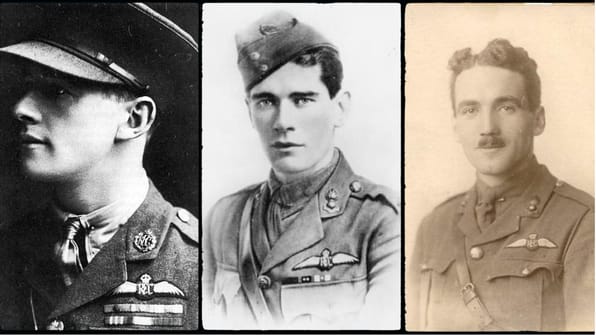
As a wartime fiction author, these pilots have been inspirational to my writing.
But it is their bravery and sacrifice that should be remembered now.